My Top Five Places to Find Statistics Resources
Published September 7, 2026 · By Matt Heywood
Statistics is the course where a lot of students discover that their usual study method stops working. In calculus you can grind through practice problems until the procedures stick. In statistics you can execute every procedure correctly and still lose the marks, because the question was never really about the arithmetic. It was about which test to run, what the output means, and whether the assumptions hold.
That makes the resource you pick matter more than it does in other courses. A video that walks you through a calculation is not the same as a worked solution that shows you why that test was the right one.
These are the five places I actually send students, whether they are in a college or university stats course or working through the same material on their own. All five are free.
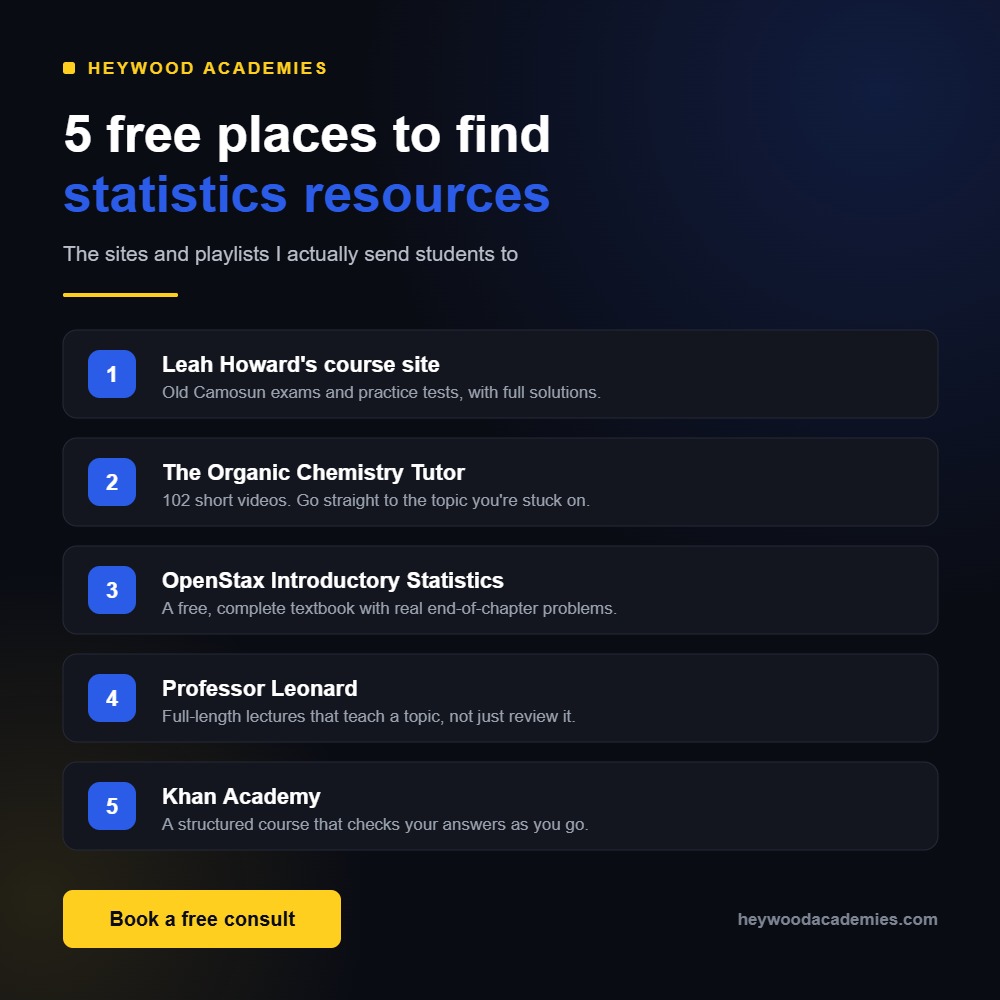
#1 Leah Howard's Course Site (Best Practice Tests)
Leah Howard teaches math at Camosun College in Victoria, and she posts her full course materials publicly. Her Stat 254 page is the one worth bookmarking.
What makes it better than most instructor sites is that the practice material comes with solutions written out properly. You get:
- Three sets of practice problems with detailed solutions
- Old exams from a previous quarter, Test One and Test Two, with solutions
- Two assignments with answer keys, plus solutions to two unit tests
- A formula sheet with the tables you are allowed to bring in
- Handouts on binomial distributions, sampling methods, and process control
Old exams with worked solutions are the single most useful thing you can get your hands on before a stats test. They tell you the format, the phrasing, and how much work the marker expects to see. Her homepage also has course pages for Math 107, 109, 156, 191, 193, 250A, 250B, 251, and 252, so it is worth a look if you are taking anything else in the math sequence.
This is the same site I point students to in my linear algebra resources roundup, alongside a couple of other Camosun instructors who post their notes.
#2 The Organic Chemistry Tutor (Best YouTube Playlists)
The name is misleading. The Organic Chemistry Tutor covers math, physics, and statistics as thoroughly as he covers chemistry, and his statistics playlist runs to 102 videos with over nine million views between them.
What I like about it is the granularity. Most of the videos are short and each one does exactly one thing, so you can go straight to the topic you are stuck on instead of scrubbing through a lecture. The playlist opens with a 57 minute "Introduction to Statistics" overview and then breaks down into pieces like:
- Descriptive Statistics vs Inferential Statistics
- Statistic vs Parameter, and Population vs Sample
- Scales of Measurement: Nominal, Ordinal, Interval, and Ratio
- How To Make a Simple Frequency Table
- Relative and Cumulative Frequency Distributions
Use this one when you have a specific gap. If you sat through a lecture on z-scores and it did not land, there is a ten minute video that will fix it tonight.
#3 OpenStax (Best Free Online Textbook)
OpenStax publishes peer-reviewed university textbooks under an open licence, which means Introductory Statistics 2e is free to read online, free to download as a PDF, and legal to keep.
It reads like a real textbook rather than a summary, and the chapters line up closely with what UVic and Camosun intro stats courses cover. The section on using the normal distribution is a good example of the style. It explains the reasoning behind finding the area under the curve, then shows both the calculator steps and the table lookup, rather than just handing you a formula.
The end-of-chapter practice sets are the reason to use it. There are enough problems there to actually build fluency, and the answers are included so you can check yourself.
If your course is more business-oriented, OpenStax also publishes Introductory Business Statistics 2e, which covers much of the same ground with different examples.
#4 Professor Leonard (The GOAT)
Professor Leonard filmed his entire statistics course and put it on YouTube. Not summaries, not highlights. Real classroom lectures, some of them close to two hours long, filmed in front of an actual class.
His Statistics (Full Length Videos) playlist is 28 videos covering data analysis and interpretation, data descriptors, probability, binomial and normal distributions, confidence intervals, and hypothesis testing. The videos are well over a decade old and the view counts are still climbing, which tells you something.
This is the resource for when you have missed a week, or when the lecture went too fast and you need someone to teach the topic properly rather than remind you of it. He works through the reasoning out loud, including the parts most instructors skip because they assume you already see them. If you would rather have it in smaller pieces, the same material is split into shorter segments on his Statistics Playlist 1.
The tradeoff is time. A two hour lecture is a two hour commitment. Use Professor Leonard to learn a topic from scratch, and The Organic Chemistry Tutor to patch a specific hole.
#5 Khan Academy (The Best Full Course)
Khan Academy's Statistics and Probability course is the only one on this list that is a structured course rather than a pile of material. It runs from analyzing categorical data through summarizing quantitative data, modeling distributions, sampling and study design, probability, random variables, confidence intervals, and significance testing.
The reason it earns a place here is the practice engine. Every unit mixes videos with exercises that check your answer immediately and tell you where you went wrong, and it tracks a mastery percentage for each unit. That feedback loop is exactly what statistics needs, because the errors in stats are usually conceptual, and you will not catch a conceptual error by rereading your notes.
My advice is to use the mastery tracker honestly. Work the exercises for a unit until it reads well above the minimum, then move on. A unit sitting at forty percent is a unit that will cost you on the final.
Where These Fit in an Actual Stats Course
Most students in Victoria hit this material in UVic STAT 255, 252, or 260, or in Camosun STAT 116 or 216. The wall in all of them lands in the same place: the shift from describing data to making inferences about a population you cannot see. I wrote about why that transition catches people out, and how to study for it, in this guide to intro statistics at UVic and Camosun.
A workable plan using the five resources above looks like this. Learn the topic with Professor Leonard or Khan Academy. Fill the specific gaps with The Organic Chemistry Tutor. Read the theory in OpenStax and work its end-of-chapter problems. Then, in the week before the test, do Leah Howard's old exams under time pressure with the solutions face down.
Our Problem Bank
The gap none of these five fully closes is worked solutions to enough problems. Videos show you one example. Textbooks give you answers but not the reasoning. Old exams are gold, but there are only so many of them.
That is what we built. Over 300 problems with the full solution written out step by step, not just the final answer, so when your attempt goes wrong you can find the exact line where it broke. Statistics is in there alongside Calculus 1, 2, and 3, differential equations, linear algebra, physics, statics, dynamics, and solid mechanics.
Taking calculus or linear algebra alongside statistics this term? I have put together the same kind of roundup for calculus resources and linear algebra resources.
Let's make statistics make sense.
Book a free consultation for statistics or any other math course, in person around Greater Victoria or online anywhere in BC.
Book a Free Consultation