If you are searching for a math tutor in Victoria, you have probably already noticed the prices are all over the map. One listing says $20 an hour, another says $90, and a big agency quotes something in between with a package attached. That gap is confusing, and it makes the real question harder to answer: what should you actually pay, and is any of it worth it?
Here is a straight breakdown of how tutoring pricing works in Greater Victoria, how in-person and online compare, and how to tell whether you are paying for real results or just paying for hours. By the end you will know what a fair rate looks like for your situation and when hiring a tutor is the right call.
What a private tutor actually costs in Victoria
Tutoring is not a regulated profession in British Columbia, so anyone can set their own rate. That is the main reason prices swing so widely. What you are really paying for is a mix of the tutor's subject expertise, teaching experience, the grade level, and whether you are hiring an individual or a company.
Here is roughly what the Victoria market looks like right now:
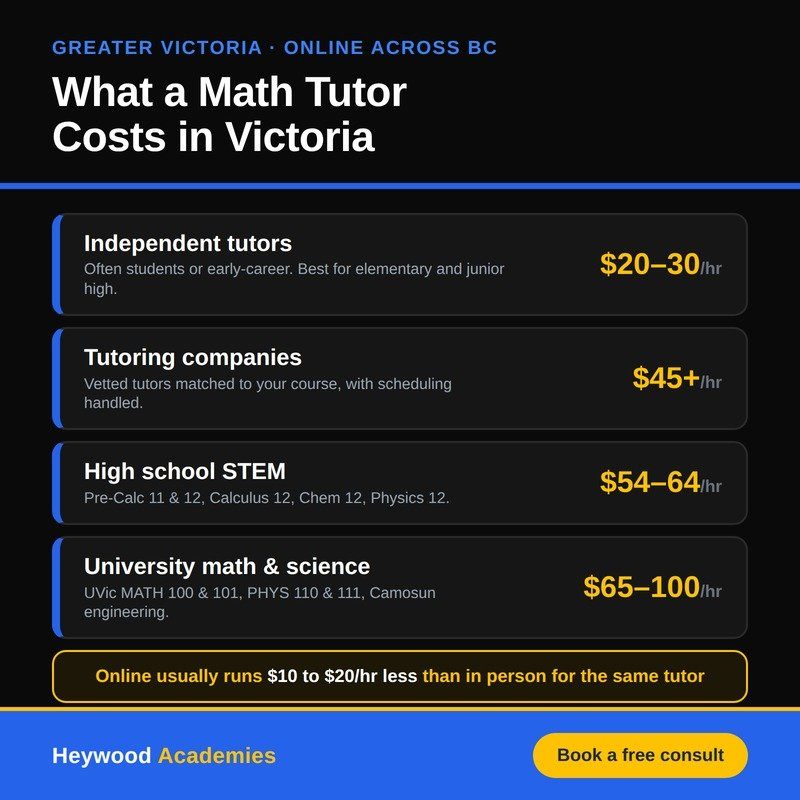
- Independent tutors: Local listings for math and science help commonly advertise around $20 to $30 per hour. These are often students or early-career tutors. Great for elementary and junior high support, less reliable for senior or university courses.
- Tutoring companies and agencies: Rates usually start around $45 per hour and climb from there. You are paying a bit more for vetting, scheduling, billing, and a tutor matched to your course. If you are weighing that model against one-to-one help, our comparison of a learning centre and a private tutor goes through the trade-offs.
- High school STEM (Pre-Calculus 11, Pre-Calculus 12, Calculus 12, Chemistry 12, Physics 12): Experienced or specialist help for senior courses tends to land in the $54 to $64 per hour range, and higher for AP or IB.
- University-level math and science (UVic MATH 100 and MATH 101, PHYS 110 and PHYS 111, first-year Camosun engineering): This is the most expensive tier, often $65 to $100 per hour, because the tutor needs current, course-specific knowledge and has to keep pace with a fast-moving semester.
For reference, our own rates at Heywood Academies are $70 per 50-minute session online and $95 per 50-minute session in person, with prepaid 8-session packages at $520 online and $720 in person, a $40 saving. Those hours never expire and are refundable less a $35 administration fee. We publish those numbers openly, which is worth looking for when you compare tutors. A rate you cannot find until after a sales call is a small red flag.
How pricing is usually structured
Most tutors charge one of three ways:
- Pay as you go. A flat hourly rate, no commitment. Best when you only need a few sessions before a midterm.
- Prepaid packages. You buy a block of hours up front, often at a lower effective rate. Best for a full-semester course where you know you will need steady support.
- Monthly plans. A set number of hours per week billed monthly. Common with larger agencies.
Watch for the small stuff that changes the real cost: minimum session lengths, travel fees for in-person sessions, and surcharges for AP, IB, or university-level work. Those add-ons are normal, but they should be stated up front.
In-person vs online: what you are really paying for
Across the market, online tutoring usually runs about $10 to $20 per hour less than in-person for the same tutor. The reason is simple. There is no travel time and no travel cost baked into the rate. That difference shows up in our own pricing too, where online sits well below the in-person rate.
So which should you choose? It depends less on price and more on the student.
In-person makes sense when the student needs the structure of a set appointment, gets easily distracted at a screen, or is working through hands-on material where sitting side by side helps. In Victoria that usually means meeting at a home, a coffee shop, or a library branch.
Online makes sense when you want flexibility, live outside the core Victoria area, or want access to a specific subject specialist who is not around the corner. A good online session should not feel like a downgrade. The tutor should be sharing a screen or a tablet so you watch the work happen in real time, and you should get the notes afterward.
This is where online tutoring genuinely widens your options. If you are in Nanaimo, the Cowichan Valley, the Interior, or anywhere else in BC, online tutoring means you are no longer limited to whoever happens to teach your course in your town. You can find someone who actually knows UVic's MATH 101 or a specific Camosun engineering course, wherever you are.
Is a math tutor in Victoria worth it?
Here is the honest answer: sometimes yes, sometimes not yet.
Tutoring is worth it when the problem is targeted and the student is willing to do the work between sessions. A few clear cases where it usually pays off:
- The student understands the material in class but falls apart on tests. This is often about exam technique and confidence, and a few focused sessions can move a grade a full letter.
- There is a specific gap holding everything else back. Weak Pre-Calculus 11 foundations quietly wreck Pre-Calculus 12 and first-year calculus. Fixing the gap fixes the downstream courses.
- A hard course is worth real money and time. If you are paying university tuition for UVic MATH 100 or a first-year engineering course, a tutor is cheap insurance against having to retake it.
And here is where a tutor is not the right spend yet:
- If the student has not tried the free help first. UVic and Camosun both offer drop-in math help, office hours, and study spaces at no cost. Use those before paying for private sessions.
- If the real issue is missed classes or no homework getting done. A tutor cannot out-teach a student who is not showing up. Fix the habit first, then bring in a tutor to accelerate.
- If you only want someone to check completed homework. That is a low-value use of a paid hour. Save tutoring for the concepts that genuinely stump the student.
The way to think about value is cost per result, not cost per hour. A $30 tutor who meets weekly for a semester with little to show for it is more expensive than a $90 session that unlocks a concept the student was stuck on for a month. What you are buying is a faster path to understanding, taught by someone who has seen exactly where students get tripped up in that course.
The quick takeaway
Expect independent tutors around $20 to $30 an hour, companies starting near $45, senior high school STEM around $54 to $64, and university-level math and science from $65 to $100. Online is typically cheaper than in-person for the same tutor. Before you pay for anything, try the free campus help. And judge value by whether the student is actually understanding more, not by the hourly number alone.
If you want a hand figuring out whether tutoring is the right move for your specific course, that is exactly what a free consult is for. We can talk through where the student is stuck, whether math tutoring makes sense right now, and what a realistic plan looks like. No pressure and no sales pitch. Reach out to book a free consultation, or join our newsletter for exam prep tips through the term. We work with students in Victoria in person and across BC online.