Every spring, Grade 10 students across Greater Victoria bring home a course selection form with a decision that feels bigger than it looks: which math to take next year. Foundations, Pre-Calculus, or Workplace. For most families we work with in Victoria and online across BC, this is the first real fork in the BC math pathways, and the choice quietly shapes which university and college programs stay open later at UVic, Camosun, and beyond.
Here is the good news up front. The streams are more flexible than the hallway rumors suggest, and a wrong turn is usually fixable if you catch it early. This guide walks through what each stream is actually for, where it leads, and how to choose with your eyes open.
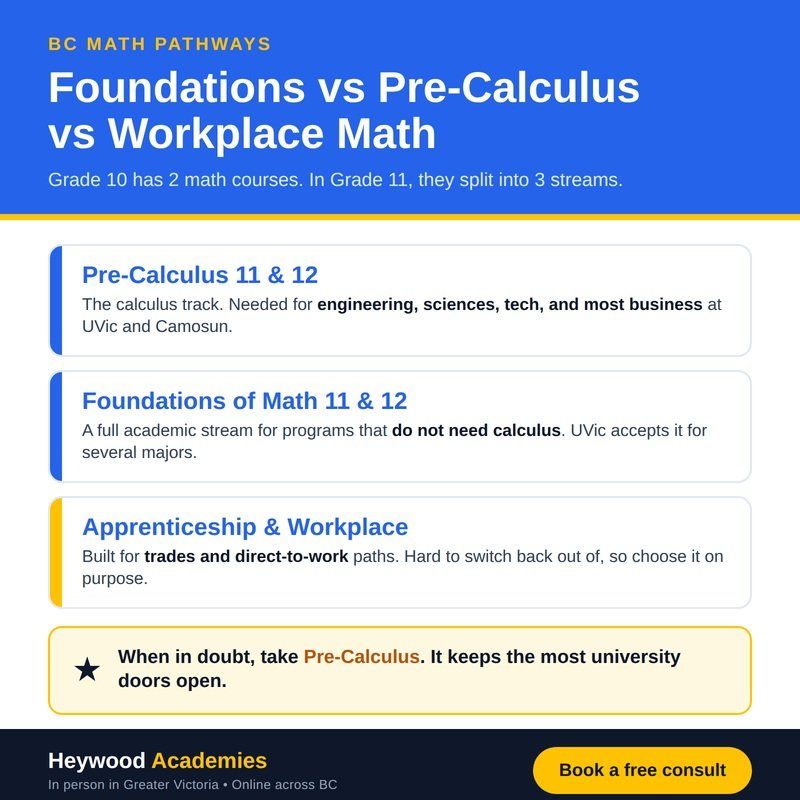
The three BC math streams, in plain terms
Up to Grade 10, there are really only two math courses in BC: Foundations of Mathematics and Pre-Calculus 10 (one combined course), and Workplace Mathematics 10. The branch into three separate streams happens in Grade 11 and 12. That surprises a lot of parents, so it is worth saying clearly: your Grade 10 choice already narrows things, and Grade 11 is where the three real pathways appear.
Here is what each one is built for, straight from the BC math curriculum, which streams differently from Alberta's:
- Pre-Calculus 11 and 12 is the stream for programs that need theoretical calculus down the road. Think sciences, engineering, computer science, and most business degrees. It covers functions, trigonometry, and algebra at the depth first-year university calculus assumes you already have.
- Foundations of Mathematics 11 and 12 is a full academic math stream for programs that do not require calculus. It leans into statistics, financial math, logic, and geometry. It is rigorous, it counts for graduation, and it is accepted by many university programs. It simply is not built to feed into calculus.
- Apprenticeship and Workplace Mathematics is designed for trades, technical college, and direct entry into the workforce. It is practical and hands-on, covering measurement, budgeting, and applied trigonometry.
None of these is the "smart kid" stream or the "give up" stream. They point at different futures, and the right one depends entirely on where your student wants to go.
Where each stream actually leads (UVic and Camosun)
This is the part families most need to get right, because the labels do not tell you the whole story.
At UVic, the picture is more forgiving than people expect. Several programs, including Computer Science and Health Information Science, accept either Foundations of Mathematics 12 or Pre-Calculus 12, according to UVic's own admission materials. So Foundations does not automatically close the university door.
The catch is calculus. Any program that runs through first-year calculus, which includes engineering, physics, chemistry, and most of the sciences, expects Pre-Calculus 12. That is the course that prepares students for MATH 100, 102, or 109, UVic's first-year calculus options. Foundations 12 will not get a student ready for that jump. And Workplace math does not appear on UVic's approved course list at all.
At Camosun, the pattern is similar. For admission purposes, Camosun's "Math 12" means either Principles of Math 12 or Pre-Calculus 12, per its admission requirement alternatives. The Engineering Transfer (First Year Engineering) certificate, which can guarantee a spot in second-year engineering at UVic with a strong enough GPA, is a Pre-Calculus program through and through.
The short version: if a science, tech, or engineering future is even a possibility, Pre-Calculus 12 is the course that keeps it possible.
The mistake we see most often
The most common misstep is not picking the "wrong" stream on purpose. It is aiming low to protect a grade. A student who finds Grade 10 math stressful, or a parent worried about a dip in the GPA, decides Foundations or Workplace will be the safer, lighter option.
Two things get missed when that happens.
First, Foundations does not lead to calculus. A student who takes Foundations 11 and 12 and then discovers in Grade 12 that they want engineering has to backfill Pre-Calculus before any university calculus course will let them in. That is doable, but it is an extra step nobody planned for.
Second, the Workplace stream is close to a one-way door. Once a student is on the Apprenticeship and Workplace track, moving back into the Foundations or Pre-Calculus stream is genuinely hard, because the courses do not cover the algebra those streams build on. Choosing Workplace in Grade 10 or 11 to lighten the load can quietly remove university options a 15-year-old was not ready to give up.
Neither of these is a disaster. Both are much easier to avoid than to undo.
On the fence? Here is how to decide
When a student genuinely cannot choose, the rule of thumb we use is simple: when in doubt, keep the calculus door open.
If there is any real chance of a career in science, engineering, technology, health, or quantitative business, take Pre-Calculus. It is easier to have the option and not need it than to need it and not have it. A student who takes Pre-Calculus and later heads to an arts or humanities program has lost nothing. A student who takes Foundations and later wants engineering has a detour ahead.
If the direction is clearly toward arts, most social sciences, or the trades, then Foundations or Workplace is a perfectly good, honest choice. There is no need to grind through Pre-Calculus out of fear.
And if a student did land in the wrong stream, there is a safety net worth knowing about. Camosun offers math upgrading, including a Pre-Calculus 12 equivalent (MATH 097) and calculus-prep courses like MATH 115 and MATH 107. A student who took Foundations, or who has been out of school for a while, can get calculus-ready without repeating high school. That is a common route to UVic and Camosun engineering, not a rare one.
Want more of this kind of straight talk on BC courses and exam prep? Join our newsletter and we will send it to your inbox.
The quick recap
- Grade 10 has two math courses; the three streams split at Grade 11.
- Pre-Calculus feeds calculus-based programs (engineering, sciences, tech, most business).
- Foundations is a real academic math stream for programs that do not need calculus, and UVic accepts it for several majors.
- Workplace math suits trades and direct-to-work paths, but it is hard to switch out of.
- When unsure, Pre-Calculus keeps the most doors open.
- Camosun upgrading is a proven backup if a student needs to become calculus-ready later.
Talk it through with someone who knows the BC system
Choosing a math stream is really a conversation about where your student wants to go, and it is a lot less stressful with someone who knows how the BC courses connect to UVic and Camosun. Heywood Academies offers math tutoring in person across Greater Victoria and online anywhere in BC, from Pre-Calculus 11 and 12 through first-year university calculus.
If you would like help thinking it through, or your student needs to get solid in Pre-Calculus before the jump, book a free consult. No pressure, just a straight answer.