UVic Calculus Help: What MATH 100 and MATH 101 Actually Demand
Published October 12, 2026 · By Mia Terry
Staring down MATH 100 or MATH 101 at UVic and feeling like the ground shifted since Calculus 12? You are not imagining it. First-year calculus at UVic moves fast and asks for a lot more than high school did. The department is blunt about that. This post is a straight-talk survival guide, and some honest UVic calculus help. We will cover what these courses really include, where students struggle, and what to do about it. It works whether you study in Victoria or online across BC.
Here is the promise. By the end, you will know which calculus course fits you and what each one demands week to week. You will also learn the number that predicts a MATH 101 pass. And you get a study plan to stay on the right side of it.
First, pick the right door: MATH 100 vs MATH 109 vs MATH 102
A surprising number of students lose ground before the term even starts by registering for the wrong calculus course.
MATH 100 (Calculus I, 1.5 units) assumes you have seen calculus before. UVic's own first-year calculus guidance highly recommends Calculus 12. UVic teaches the course expecting you to have met limits and derivatives already. To register, you need one of these:
- Pre-Calculus 12 (73% or higher)
- Principles of Mathematics 12 (73% or higher)
- MATH 120 with a C+
MATH 109 matches MATH 100 in difficulty and lands you in the same place. The difference is that it assumes no prior calculus. Same textbook, same learning objectives, just a lesson plan that does not expect you to know the derivative already. Took Pre-Calculus 12 but skipped Calculus 12? MATH 109 is often the smarter door.
MATH 102 is the trap. It targets the social and biological sciences, and it does not prepare you for MATH 101. Does your program need Calculus II, or list MATH 100 as a prerequisite anywhere? Then skip MATH 102. It uses a different textbook and will not get you into 101.
One more detail catches people. UVic grants credit for only one of MATH 100, MATH 102, or MATH 109. You cannot collect all three, so choose deliberately.
What MATH 100 actually demands
MATH 100 is single-variable differential calculus. It runs through limits and continuity, then the derivatives of polynomial, trigonometric, exponential, and logarithmic functions. From there it hits the big applications: curve sketching, optimization, and related rates. It closes with the first steps into integration, including the Mean Value Theorem and the Fundamental Theorem of Calculus.
On paper, that looks like Calculus 12 with a few extra chapters. It is not. Two things change.
The pace. UVic can cover in one lecture what a high school class spends a week on. Miss one idea and the next three build on the gap.
The expectations. Calculus 12 often rewards plugging into a memorized procedure. MATH 100 wants more. You have to understand why the procedure works, not just how. Then you set up the problem yourself and tackle "show that" questions where nobody hands you the method. Related rates and optimization bite hardest here. The calculus is easy once you have the equation, and building that equation is the whole battle.
Here is a tip that separates the A students from the strugglers. For every worked example in lecture, redo it from a blank page within a day, no notes. Cannot reproduce it cold? Then you have not learned it, you have only recognized it. Recognition feels just like understanding, right up until the midterm proves otherwise.
Want the full course reviewed in one sitting before an exam? Here's our complete MATH 100 / Calculus 1 final exam review:
What MATH 101 actually demands, and the number that predicts your grade
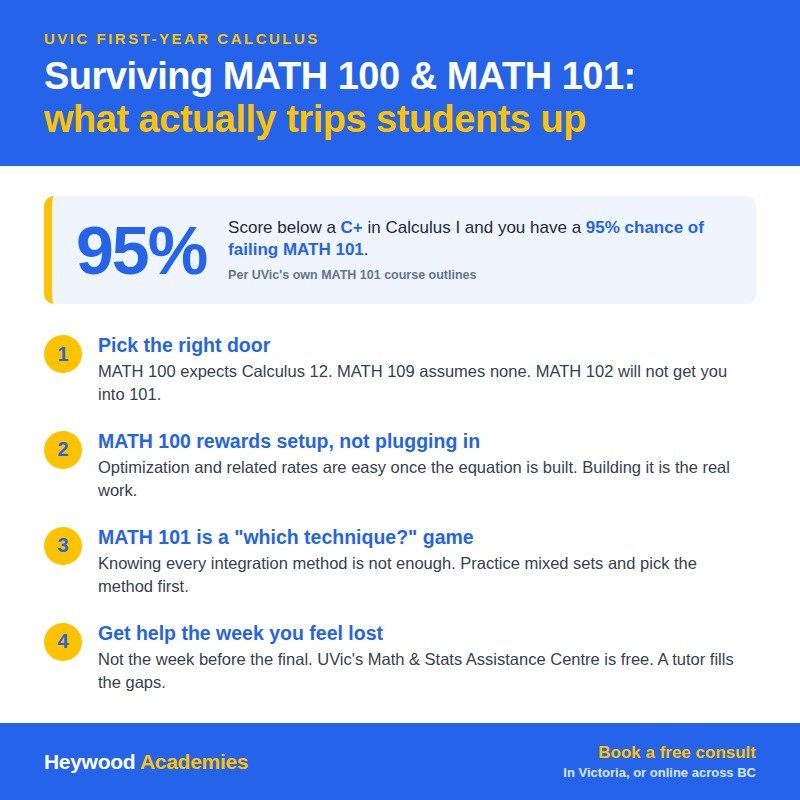
MATH 101 (Calculus II, 1.5 units) is where first-year calculus separates people, and UVic does not hide it. For years, the MATH 101 course outlines have said it plainly. Score below C+ in MATH 100 or 109, and the department's own numbers give you a 95% chance of failing.
Read that again. Not "you might struggle." A 95% failure rate. That one line is the most useful planning info UVic gives you. It marks exactly where the bar sits. A C+ in Calculus I is not a comfortable pass. MATH 101 builds directly on it.
Why Calculus II is so much harder
The mindset changes. In 100, the prompt often tells you the technique. In 101, you get a problem and have to figure out which of a dozen techniques applies. The course teaches many integration methods: integration by parts, trigonometric substitution, partial fractions, and more. Doing any single method is not the hard part. The hard part is spotting which one a given integral wants.
From there, 101 keeps piling on tools. You get applications of the integral, like volumes of solids, arc length, and exponential growth and decay. You get separable differential equations and improper integrals. Then the course ends on infinite sequences and series. You learn a battery of convergence tests and, once again, have to pick the right one.
That "which tool" instinct is the entire ballgame in 101. Some students memorize each technique in isolation and skip mixed practice. They reach the final able to run every method, yet unable to start a single question. The exam never tells them which one to use.
The fix is simple to state and harder to do. Once you have three or four techniques down, stop drilling them one chapter at a time. Build a shuffled set that mixes them, and decide the method before you compute anything. In 101, choosing the approach is most of the mark. Our roundup of calculus resources is a good place to find mixed problem sets to practise on.
Same idea for MATH 101 / Calculus 2, reviewed start to finish:
How not to become the 95%
If you are pre-engineering, this matters even more. Declaring into an engineering program at UVic takes a C or better in both Calculus I and MATH 101. Those two courses sit right between you and your program. Grinding through the ENGR 141 crunch too? The same habits below carry straight over.
A few things actually move the needle:
Use the free help first. At UVic's Mathematics and Statistics Assistance Centre, teaching assistants staff a drop-in space. They help with first and second year material at no cost. On campus? Go early and go often, before you fall behind rather than after. We rounded up more no-cost options in our guide to free academic resources at UVic.
Do problems, not notes. Calculus is not a reading subject. Rereading solved examples builds false confidence. The real signal is whether you can solve unseen problems on a blank page, under time pressure.
Get help before the C+ becomes a C. The 95% number is really about foundations. A small gap in MATH 100 turns into a wall in MATH 101. The cheapest time to close it is the week you first feel lost, not the week before the final. This is where a few focused sessions earn their keep. Shore up derivative applications in 100, or build that "which technique" instinct in 101. Either way, you skip the April panic. We tutor UVic students in person across Greater Victoria and online anywhere in BC, same courses, same content.
The bottom line, and where to get UVic calculus help
MATH 100 and MATH 101 are not Calculus 12 with a UVic sticker. The first course asks you to understand and set up, not just compute. The second asks you to choose the right tool from many. It rests on a real C+ from Calculus I, with the department's own 95% failure rate below that line. So pick the right course, redo examples from blank pages, and mix your practice. Get help the week you first feel behind, not the month after. If a midterm has already gone badly, our recovery guide for UVic and Camosun students walks through the next steps.
Want a hand staying on the right side of that C+? Book a free consult with our calculus tutors and we will map out where you are and what to shore up first. In person across Greater Victoria, or online anywhere in BC.
Not ready to book yet? Join our newsletter for exam-prep and study tips through the term.
Get MATH 100 and MATH 101 help at UVic.
Book a free consultation and we'll map out where the gap is, then build the setup skills and technique-picking instinct these courses actually test.
Book a Free Consultation