Finished a technology diploma and now want the letters P.Eng. after your name? You do not have to start a degree over from scratch. Camosun College has a direct route into third year of a Bachelor of Engineering at the University of Victoria. It is one of the few programs of its kind in Canada.
It is called the Engineering Bridge, and it is a well-worn path. Heywood's founder, Matt, went through it himself. So this is not a summary of a brochure. It is how the transfer actually works, what it takes to get in, and where students stumble.
By the end you will know the real timeline and the GPA you actually need. You will also see what the bridge year looks like week to week, plus how to prep the math.
What the bridge actually is
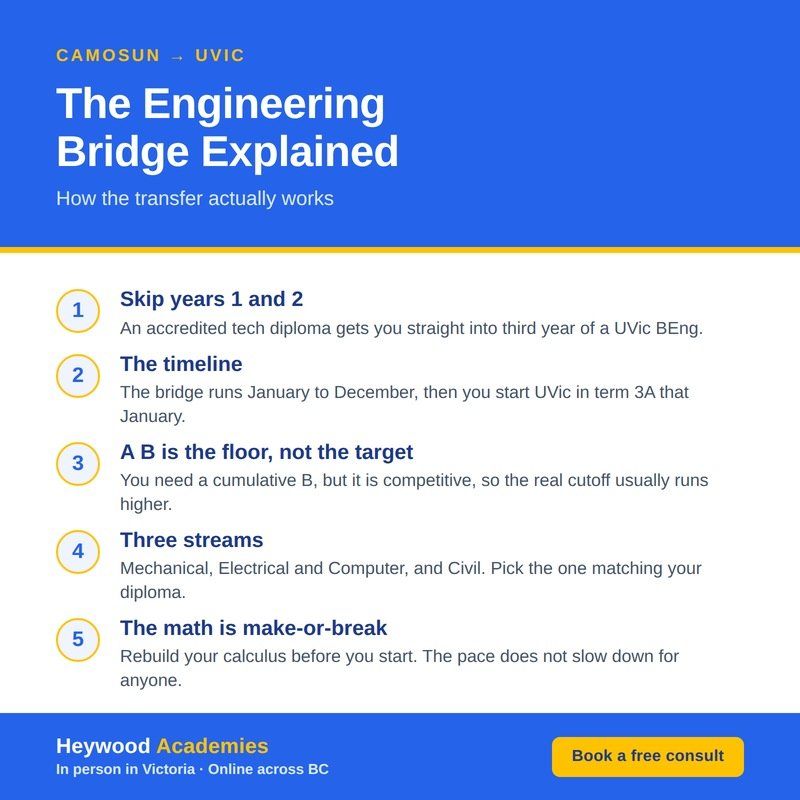
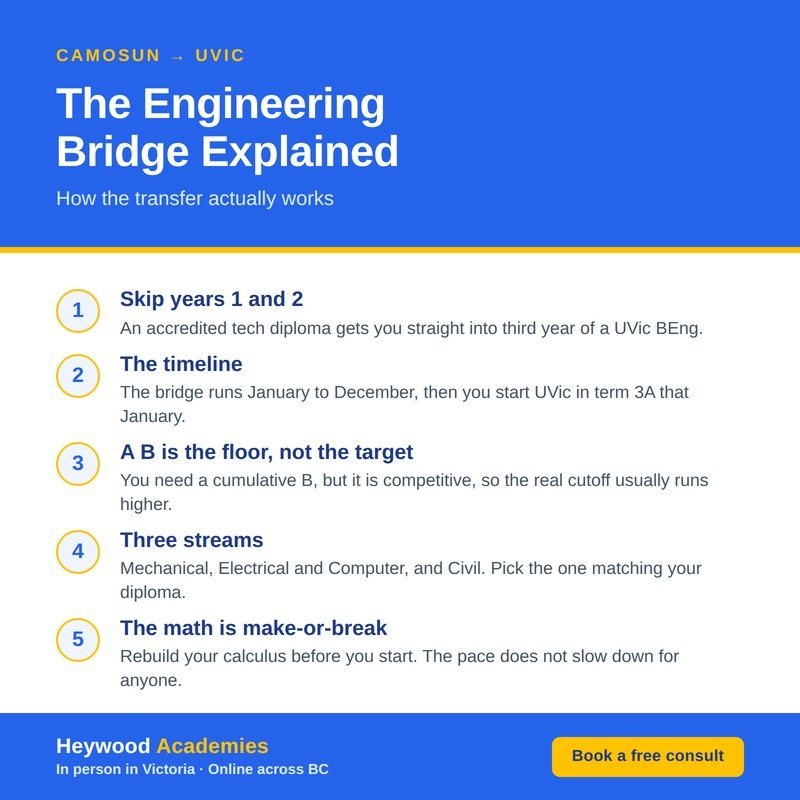
UVic and Camosun run the Engineering Bridge together. With an accredited two-year engineering technology diploma, you enter third year of a UVic BEng directly. You skip repeating first and second year.
The reason it exists is simple. A technology diploma and an engineering degree do not cover the same ground. Diplomas are hands-on and applied. Degrees lean much harder on math and theory. The bridge fills that gap. The program covers the first- and second-year math, science, computer science, and engineering that a technology diploma skips. That way you walk into UVic's third year (term 3A) ready to keep up.
There are three streams: Mechanical, Electrical and Computer, and Civil. You pick the one that matches your diploma and the UVic degree you want. The Electrical and Computer bridge, for example, has 14 courses.
Who actually gets in
This is the part students underestimate. Meeting the minimum is not the same as getting a seat.
To be eligible you generally need:
- An engineering technology diploma (Mechanical, Electrical, Electronics, Civil, or a closely related field) that Technology Accreditation Canada accredits. You must have finished it within the last five years.
- A minimum cumulative GPA of 5.0, which is a B, with no course below a C.
- All of your high school and post-secondary transcripts, whether or not they seem relevant.
If your diploma is more than five years old, you can still apply. You will just need a letter of intent describing your work and professional development since graduating.
Here is the trap. That B is the floor, not the target. Camosun and UVic hold a joint meeting, rank applicants by GPA, and offer seats from the top down. The program is highly competitive and seats are few, so the real cutoff usually sits well above a straight B. International diplomas do not qualify, due to engineering accreditation rules.
The takeaway: if you are still in your diploma, every grade counts toward getting in. Do not treat your final year as a coast.
What the bridge year looks like
The bridge to UVic runs from January through December, across two academic terms. Each term is about 14 weeks of classes plus an exam period. You are in class 25 to 28 hours a week. Camosun's own homework estimate is three to four hours a day, weekends included. It is a full, demanding year, closer to a job than a light course load.
Between the two terms there is an optional internship work term from May to August. It is worth considering if you want industry experience before you reach UVic.
Finish the bridge in December and you start UVic in term 3A the following January. From there the BEng requires terms 3A, 3B, 4A, and 4B, plus four four-month co-op work terms. Already have relevant work terms from your diploma, or years of technical employment? You can credit or challenge up to two of those co-op terms and shorten your time to graduation.
All of this happens at Camosun's Interurban campus, about nine kilometres from UVic. You stay in Greater Victoria the whole way through.
How to set yourself up so the math does not sink you
Ask anyone who has done the bridge and the same theme comes up: the math. A technology diploma does not demand the calculus, linear algebra, and differential equations a degree assumes you have. The bridge compresses a lot of that into one intense year. If your foundations are shaky, everything after it gets harder.
Two things make the difference.
First, timing. If any time has passed since you last did calculus, do not walk in cold. Camosun itself advises returning students to review their math first. Rebuild your fluency in algebra, trigonometry, and first-year calculus before the bridge starts. That is the material behind UVic's MATH 100 and MATH 101, and it pays off right away.
Second, support during the year. The pace does not slow down for anyone. The students who thrive get help early, not after the first rough midterm.
This is where Heywood's engineering tutoring comes in. We work with students across exactly this stretch. That means shoring up pre-calculus and calculus before the bridge. Then we keep you on pace once it starts. Then we handle first- and second-year UVic math once you are in the degree. We tutor in person across Greater Victoria and online anywhere in BC. It works whether you are near Interurban or logging in from another part of the province.
The short version
- The bridge lets accredited technology diploma grads enter third year of a UVic BEng. No repeating years one and two.
- It runs January to December, two hard terms, then you start UVic the following January.
- You need an accredited diploma from the last five years and a cumulative B. Competition sets the real cutoff, and it usually runs higher.
- Streams are Mechanical, Electrical and Computer, and Civil.
- The math is the make-or-break piece. Prepare before you start, and get support during.
Before you commit, confirm the current intake dates and your stream's exact course list. Check Camosun's program pages or ask the Engineering Bridge department, since details shift year to year.
If you are weighing this path, or already in it and feeling the pace, book a free consult with Heywood. We will map out a prep plan that fits your timeline. In person in Victoria or online across BC.