Opening the grade portal and seeing a failed midterm is a gut punch. Your brain jumps straight to the worst case: you are going to fail the whole course, wreck your GPA, and blow up your degree plan. Take a breath. A bad midterm is not the same as a failed course, and most of the time you have more room to recover than the panic is telling you.
This guide walks you through exactly what to do next, whether you are at UVic, Camosun, or studying online somewhere else in BC. As a math, science, and engineering tutor in Victoria, I have watched plenty of students come back from a failed midterm. I have also seen a few where the honest answer was to drop the course, and I will be straight with you about how to tell the difference.
First, stop panic cramming after a failed midterm
The most common mistake I see is the panic cram. A student gets the bad grade, feels sick about it, and immediately buries themselves in eight hours of unfocused studying that same night. They finish exhausted, retain almost nothing, and feel even worse. This does not help.
A student I worked with once bombed the midterm in her mechanics course. It was the only midterm in the class and worth 30 percent of her grade, so it felt like the end of the world. She was convinced she was done for the term. She was not. We made a plan, she put in real focused work over the following weeks, and she passed the class. One bad result on a single test did not decide her grade. The work she did afterward did.
So before you study a single thing, put the flashcards down. The first useful move is not more studying. It is figuring out where you actually stand, which is the next section.
Do the math: can you still pass?
A failed midterm feels like a disaster right up until you see the actual numbers. Pull up your syllabus and find the grade weightings. Then do about twenty minutes of arithmetic. This one step replaces a week of anxious guessing.
Here is a common setup. Say your course is:
- Midterm: 25 percent of the grade, and you scored 30 percent
- Assignments: 25 percent of the grade, and you are averaging 80 percent
- Final exam: 50 percent of the grade
Now add up the marks you have already locked in. The midterm is worth 25 percent of the grade and you scored 30 percent, so it earns you a quarter of 30, which is 7.5 out of 100 toward your final grade. The assignments are also worth 25 percent and you are averaging 80 percent, so they earn you a quarter of 80, which is 20 out of 100. Together that is 27.5 out of 100 already banked before the final.
To pass the course you need 50 out of 100 overall, so the final has to make up the missing 22.5. Since the final is worth 50 percent of your grade, scoring 45 percent on it gets you exactly those 22.5 marks. In other words, 45 percent on the final is all you need to pass. Very passable. In a case like this, recovery is not just possible, it is likely if you put in steady work.
Now the honest part. Sometimes the math is friendly and sometimes it is not. If you need to hold a B for your program and the same numbers above required you to score 91 percent on the final, that is a completely different conversation. When the number you need is unrealistic given how you have performed so far, cutting your losses early is often the smart move, not the shameful one. The math tells you which fight you are actually in.
Talk to your professor before you make any big decisions
The second most common mistake after a failed midterm is going silent. It is tempting to keep your head down and avoid the professor, but that is the opposite of what helps. Your professor is the single best-informed person on whether a comeback is realistic. They know how the final tends to compare to the midterm, whether the class usually gets a curve, and whether there is a policy you have not noticed, like a dropped lowest score or a make-up option.
Keep the conversation short and specific. Go to office hours or send a brief email along these lines: “I did poorly on the midterm and I want to turn it around. Based on how the rest of the course is weighted, is passing realistic, and what would you focus on if you were me?” That is it.
No professor has ever thought less of a student for showing up and asking how to fix things. Most respect it.
Know your deadlines: dropping a course without the penalties
If the math and your professor both point toward cutting losses, do it on time and do it officially. There are two separate clocks running: your money (the refund) and your transcript (a failing grade versus a clean withdrawal).
At UVic, there is a short window early in the term for a full tuition refund. After that comes a 50 percent tuition reduction deadline partway through the term. The one that matters most for your record is the last day to withdraw without a penalty of failure. Withdraw by that date and you get a withdrawal notation instead of an F, which protects your GPA. Miss it and your only route out is an academic concession for something like illness, an accident, or a family emergency, and you will normally still be charged full tuition. You drop online and notify Undergraduate Records. Check the exact dates for your term on the UVic academic important dates page and the withdrawal page.
At Camosun, the refund window is tight. You only get a full refund if you drop by the day before classes start, then an 80 percent refund for roughly the first week, minus the non-refundable deposit. After that, there is no refund. The transcript clock is more forgiving: you can withdraw and receive a “W”, which does not affect your GPA, right up until the last day of instruction. You must withdraw officially through myCamosun, though. Simply telling your instructor does not count. If a serious medical or compassionate situation is involved, a late withdrawal with a possible refund may be available. Check the current dates on the Camosun important dates page.
Exact dates shift every term, so always confirm on the official pages before you rely on them. The structure, though, stays roughly the same year to year.
Your study plan for the weeks before the final
If you have decided to stay in and fight for the pass, here is what a realistic plan looks like, and it is not an all-nighter.
Work backward from the final exam date. List every topic, then rank them two ways: by how much of the exam they are worth, and by how shaky you feel on them. The topics that are both heavily weighted and shaky are where your hours should go first.
Then study by doing, not by rereading. For math and science that means working practice problems under timed conditions, then going back over the ones you got wrong until you understand why. Rereading your notes feels productive and mostly is not. Book help early for the two or three topics that keep tripping you, rather than the night before, when it is too late to fix real gaps.
Spread across a few weeks, this beats one desperate cram every single time.
Recovering from a failed midterm: the takeaway
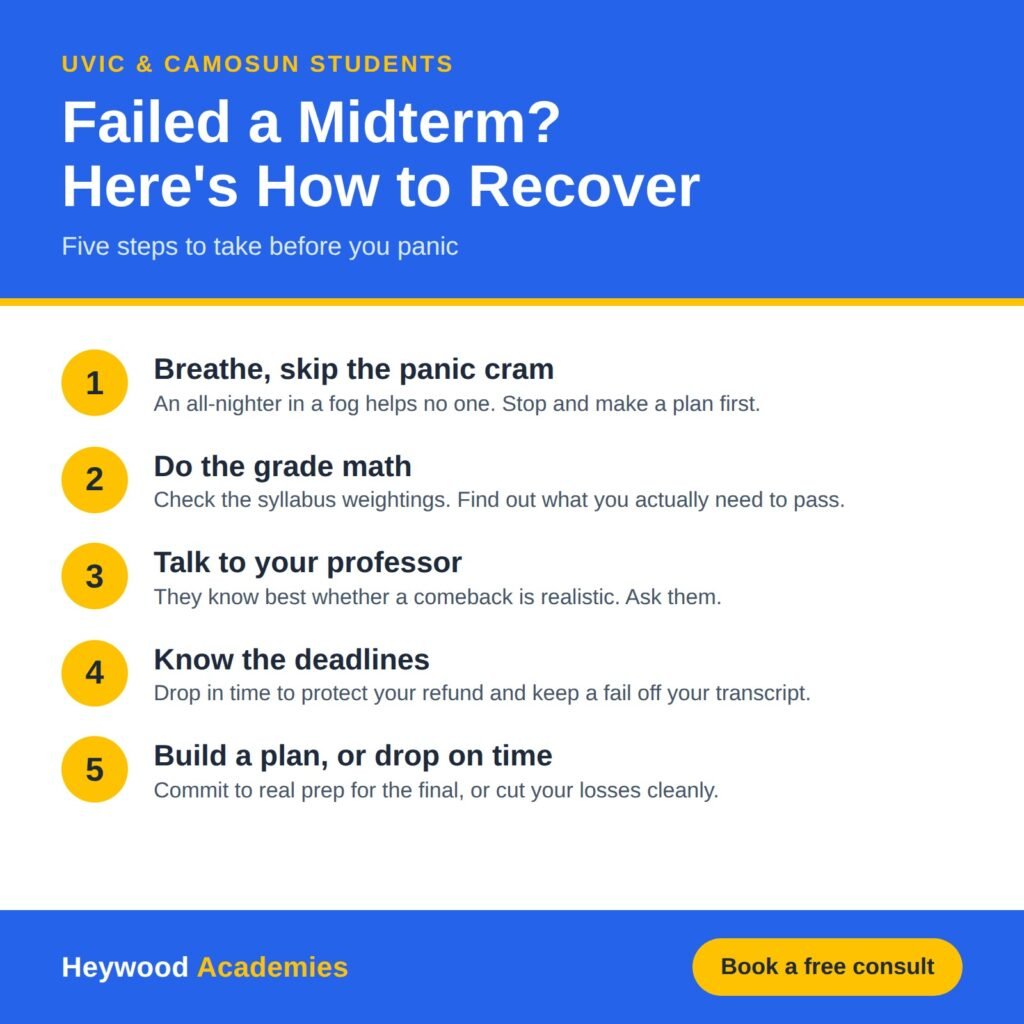
A failed midterm is a data point, not a verdict. Here is the whole recovery process in five steps:
- Breathe, and skip the panic cram.
- Do the twenty-minute grade math to see if passing is realistic.
- Talk to your professor about your real chances.
- Know your two deadlines, for the refund and for the clean withdrawal.
- Either build a proper study plan, or drop the course cleanly and on time.
Do those, and you’ll have handled the situation about as well as anyone could.
If you want help with any of it, from the grade math to a study plan for your final, book a free consultation with Heywood Academies. We tutor math and science in person across Greater Victoria and online right across BC. And for regular exam-prep tips through the term, join our newsletter.