If you are taking Biology in BC, here is the first thing worth knowing: the courses most students still call “Biology 11” and “Biology 12” are officially Life Sciences 11 and Anatomy and Physiology 12 under the redesigned provincial curriculum. The names changed, and so did the focus. The new curriculum rewards conceptual understanding and application over memorization, and as a biology tutor in Victoria, that is the shift I see catch strong students off guard more than anything else.
This guide covers the units where students most often get stuck, the mistakes that come up again and again, and the study habits that actually work for a subject that is equal parts diagrams and written explanation. By the end you will know where to spend your study time and how to study in a way that matches the exams these courses actually give.
What Biology 11 and 12 actually cover
It helps to know the shape of each course before you plan how to study.
Life Sciences 11 (formerly Biology 11) is built around three big ideas: life functions at the cellular level, evolution happens at the population level, and organisms are grouped by shared characteristics. In practice you move through experimental design, cells and microscopy, ecology, the basics of DNA, evolution and natural selection, and then a long tour of biodiversity: viruses and bacteria, protists and fungi, plants, and animals, usually with virtual dissections and biological drawings.
Anatomy and Physiology 12 (formerly Biology 12) is organized around homeostasis, gene expression, and organ systems. The first half is cellular and biochemical: biological molecules, enzymes and metabolism, membrane transport, DNA replication, and protein synthesis. The second half is the human body, covering the nervous, endocrine, digestive, cardiovascular, and respiratory systems, all framed around how the body keeps itself in balance.
Notice the pattern. Grade 11 goes wide across the diversity of life, and Grade 12 goes deep into how one organism, you, works at the molecular and system level. They reward slightly different study approaches, which we will get to.
Cell biology and biochemistry
This is where memorizing stops being enough. You can recite the parts of the cell membrane and still lose marks because the question asks you to predict what happens to a cell placed in salt water, or to explain why an enzyme stops working at high temperature. The content is not hard to read. It is hard to apply.
The fix is to always push one step past the definition. Do not stop at “the mitochondria produces ATP.” Ask what uses that ATP, and what happens if it runs out. The exam questions live in that follow-up.
Genetics and gene expression
Two words derail more students here than any others: mitosis and meiosis. They sound alike, they both involve cells dividing, and they get blurred together constantly. The distinction that sticks:
- Mitosis makes two identical copies. It is for growth and repair. One cell in, two matching cells out.
- Meiosis makes four non-identical sex cells with half the chromosomes. It is for reproduction, and it is the source of genetic variation.
If you can explain why meiosis needs to halve the chromosome number, so that fertilization restores the full number instead of doubling it every generation, you understand it. If you are just memorizing which one has “one division” versus “two,” it will slip away by the exam.
Gene expression, DNA to RNA to protein, is the other genetics chokepoint, especially in Anatomy and Physiology 12. Treat it as a process with a purpose, not a list of terms to recall.
Evolution and natural selection
Almost everyone thinks they understand natural selection, and almost everyone gets it subtly wrong. The most common mistake is believing that organisms change because they need to, that a giraffe grew a longer neck to reach leaves, or that individuals adapt within their lifetime and pass those changes on.
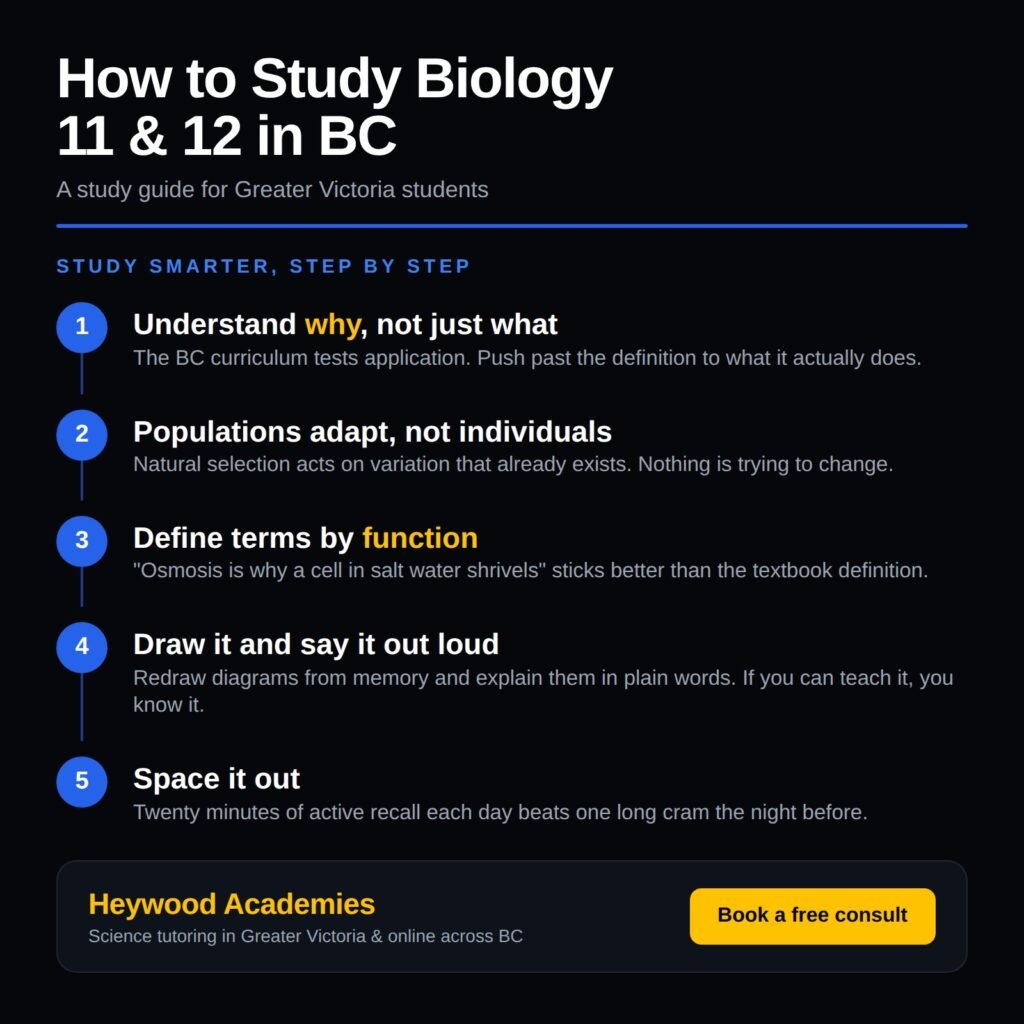
That is not how it works. Natural selection acts on variation that already exists in a population. Individuals do not adapt. Populations do, across generations, because the individuals whose existing traits happen to suit the environment survive and reproduce more. Nothing is trying to change, and there is no goal.
Getting this right matters because the BC curriculum frames evolution as something that happens at the population level. The wording in the exam questions assumes you have internalized that.
Study strategies a Victoria biology tutor actually uses
Biology is a strange hybrid. It is diagram heavy like a visual subject, but it is assessed largely through written explanation. Methods that work for math or history both fall short here. A few approaches that consistently help:
Draw it, do not just read it. For any process, the cell cycle, protein synthesis, a feedback loop, or the flow of blood through the heart, redraw the diagram from memory, then check it against your notes. If you cannot reproduce it, you do not know it yet. This beats rereading because it forces you to notice the gaps.
Explain it out loud in plain language. If you can teach mitosis to someone who has never heard of it, using no jargon, you understand it. If you fall back on textbook phrases you cannot unpack, that is the topic to review. Biology exams reward clear written answers, and the fastest way to write clearly is to first be able to say it clearly.
Define terms by function, not by rote. These courses carry a heavy vocabulary load. Instead of “osmosis is the movement of water across a membrane,” write “osmosis is why a cell in salt water shrivels.” Anchoring each term to what it does makes it stick and makes it usable in application questions.
Space it out. Biology has too much content to cram. Twenty minutes a day of active recall across a unit beats a five hour session the night before, and that is especially true in Grade 11 where the sheer breadth of organisms means you are juggling a lot at once.
Practice application questions, not just recall. Because the curriculum prioritizes application, look for questions that start with “predict,” “explain why,” or “what would happen if.” Flashcards alone will get you a passing grade and a nasty surprise on the exam.
Resources worth using
You do not need many resources. You need a couple of good ones used well.
- Khan Academy Biology is the standout for the conceptual, cell and genetics side of both courses. Its genetics section explains mitosis, meiosis, and gene expression with animations that make the processes click in a way static notes rarely do. It is free.
- The official BC curriculum pages for Life Sciences 11 and Anatomy and Physiology 12 tell you exactly what you are expected to understand and do. Reading the big ideas removes the guesswork about what an exam can ask.
- Your teacher’s diagrams and past assignments. The most underused resource of all. BC courses are marked against specific competencies, and your teacher’s materials are the closest guide to how those get assessed.
If you would rather have someone spot exactly where your understanding breaks, that is what we do. Our Greater Victoria biology tutors work with local high school students in person and with students across BC online. Book a free consult and we will figure out where to focus.
The quick takeaway
The BC Biology curriculum rewards students who understand why over students who memorize what. The three units that trip people up, cell biology, genetics, and evolution, all share the same fix: push past the definition to the function, draw the process instead of rereading it, and practice explaining it in plain words. Do that in short, regular sessions and you will be studying for the exam these courses actually give.
Stuck on a unit that will not click? A single focused session with a biology tutor in Victoria is often the fastest way past a wall like meiosis or natural selection. Book a free consultation to get started, or join our newsletter for exam prep tips through the school year. Sessions are available in Greater Victoria and online anywhere in BC.