ENGR 141 at UVic is the course where a lot of first-year engineering students figure out what engineering actually feels like. The math is familiar enough. The physics looks like stuff you’ve seen before. And then you get handed a problem with a loaded beam, three supports, and a friction angle, and you realize the rules changed when you weren’t looking.
If you’re taking ENGR 141 this term, or you’re about to, here’s what the course is really about and how to stay on top of it.
What ENGR 141 actually is
ENGR 141: Engineering Mechanics is a first-year statics course. Statics is the study of objects that aren’t moving, which sounds easy until you understand what that really means: every force and every moment acting on the object has to cancel out perfectly. Your whole job is to find the forces that make that happen.
The course walks through this in a fairly predictable order:
- Force vectors and vector algebra
- Equilibrium of a particle
- Force system resultants: moments, couples, and distributed loads
- Equilibrium of rigid bodies
- Structures: trusses, frames, and machines
- Internal loads, including shear and bending moment diagrams
- Friction
- Centroids of lines, areas, and volumes
The course follows Hibbeler’s Engineering Mechanics: Statics & Dynamics and includes both weekly lectures and graded tutorials. The tutorials are an important part of the course, giving you a chance to apply what you’ve learned while earning marks thoughout the term.
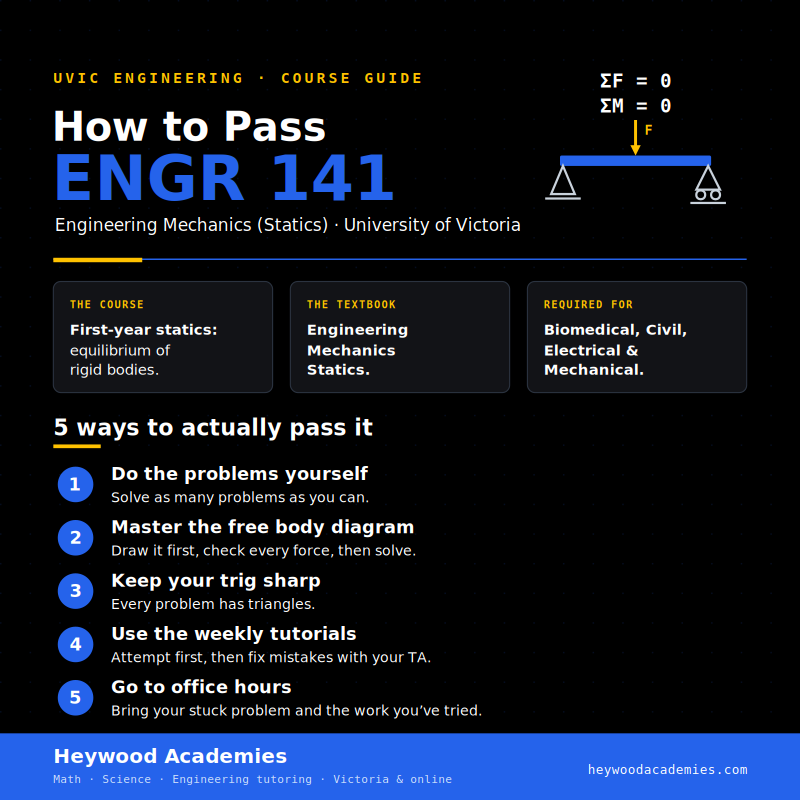
One thing worth knowing early: ENGR 141 is a required course for Biomedical, Civil, Electrical, and Mechanical engineering at UVic. It isn’t required for Computer or Software Engineering, though it can count as a technical elective if you’ve already taken it. If you’re in one of the programs that needs it, this course is a foundation you’ll be standing on for years. Solid mechanics, dynamics, and structural courses all assume you came out of ENGR 141 actually understanding the material, not just surviving it.
Why students struggle with it
Most students who struggle with ENGR 141 aren’t bad at math or physics. They get tripped up by something more specific.
The free body diagram is the whole game, and nobody slows down for it. Almost every statics problem lives or dies on whether you drew the free body diagram correctly. Forget a reaction force, point an arrow the wrong way, or miss a support condition, and the rest of your work is clean algebra applied to the wrong problem. Students tend to rush the diagram to get to the “real” math, when the diagram is the real work.
It’s relentless. The topics build directly on each other. If your vectors are shaky, moments will be shaky. If moments are shaky, rigid-body equilibrium falls apart, and by the time you hit frames and machines you’re lost. There’s no coasting through a soft week and catching up later. Falling two weeks behind in ENGR 141 is genuinely hard to recover from.
Reading the textbook is not the same as applying the concepts yourself. This is the single most common mistake. Statics looks understandable when you watch someone else solve it. Then you sit down with a blank page and have no idea where to start. The gap between “I followed that” and “I can do that” is enormous in this course.
How to actually do well
The good news is that ENGR 141 rewards a specific kind of effort, and it’s effort you control.
Do a lot of problems. More than feels reasonable. Ask any student who did well in ENGR 141 and they’ll tell you the same thing: you have to work through a large chunk of the textbook problems yourself. Not read the solutions, not watch a video, actually grind through them with a blank page. If you only do the assigned questions, you’re underprepared for the exams.
Master the free body diagram before anything else. For every problem, draw the diagram first and double-check it before you write a single equation. Get in the habit of asking: have I accounted for every support? Every applied load? Every reaction? This one habit prevents more lost marks than anything else.
Keep your fundamentals sharp. Statics leans on trigonometry and vector math constantly. If your trig is rusty, fix it in week one, not the night before the midterm. A small weakness in the basics compounds fast in this course. One thing worth knowing: ENGR 141 doesn’t lean heavily on the dot product the way some statics courses do, so don’t over-invest your study time there. Your trig, your component breakdowns, and your free body diagrams matter far more.
Use the tutorials and don’t fall behind. The weekly tutorials are where you get to work problems with a TA nearby to catch your mistakes in real time. Show up, attempt the problems before you arrive, and ask questions. And if you feel yourself slipping behind, deal with it that week. The course does not wait.
Go to office hours. This is the most underused resource in the entire course. Office hours are a chance to get your specific questions answered by the instructor or TA, one on one, with no pressure. Bring the exact problem you’re stuck on, show what you’ve tried, and ask where it’s going wrong. Even showing up a few times makes a real difference, and instructors notice the students who put in the effort to be there.
Resources worth using
A couple of free YouTube resources cover almost everything in ENGR 141 and pair perfectly with the “do a lot of problems” approach:
- Jeff Hanson’s Statics playlist — Jeff Hanson is a lecturer at Texas Tech and one of the best statics explainers on YouTube. His videos walk through the theory clearly and follow the same topic order as the Hibbeler textbook the course uses. Watch these when a concept isn’t clicking from lecture.
- Question Solutions Statics playlist — step-by-step worked solutions to Hibbeler problems. Use these to check your work after you’ve attempted a problem yourself, not as a substitute for trying. If you’re stuck, attempt it first, then watch how they set up the free body diagram and solve.
The right way to use both: try the problem on a blank page, get stuck, then watch. Watching without attempting first feels productive but doesn’t build the skill the exams test.
When to get help
ENGR 141 is one of those courses where a few hours of focused help early can change your whole term. If you’re staring at free body diagrams that don’t make sense, or you’re doing the problems but still bombing the assignments, that’s usually a sign there’s a specific concept that hasn’t clicked, and it’s fixable.
At Heywood Academies, statics is one of our core subjects. Our founder is an engineer, and ENGR 141 and the courses that follow it are exactly the kind of material we work on every term with UVic students. We offer in-person tutoring in Victoria and online tutoring for students across BC.
If ENGR 141 is giving you trouble, reach out before it snowballs. The earlier you sort out the fundamentals, the easier everything built on top of them becomes.
Book a free consultation to talk through where you’re stuck and how our engineering tutoring can help you get back on track in ENGR 141.