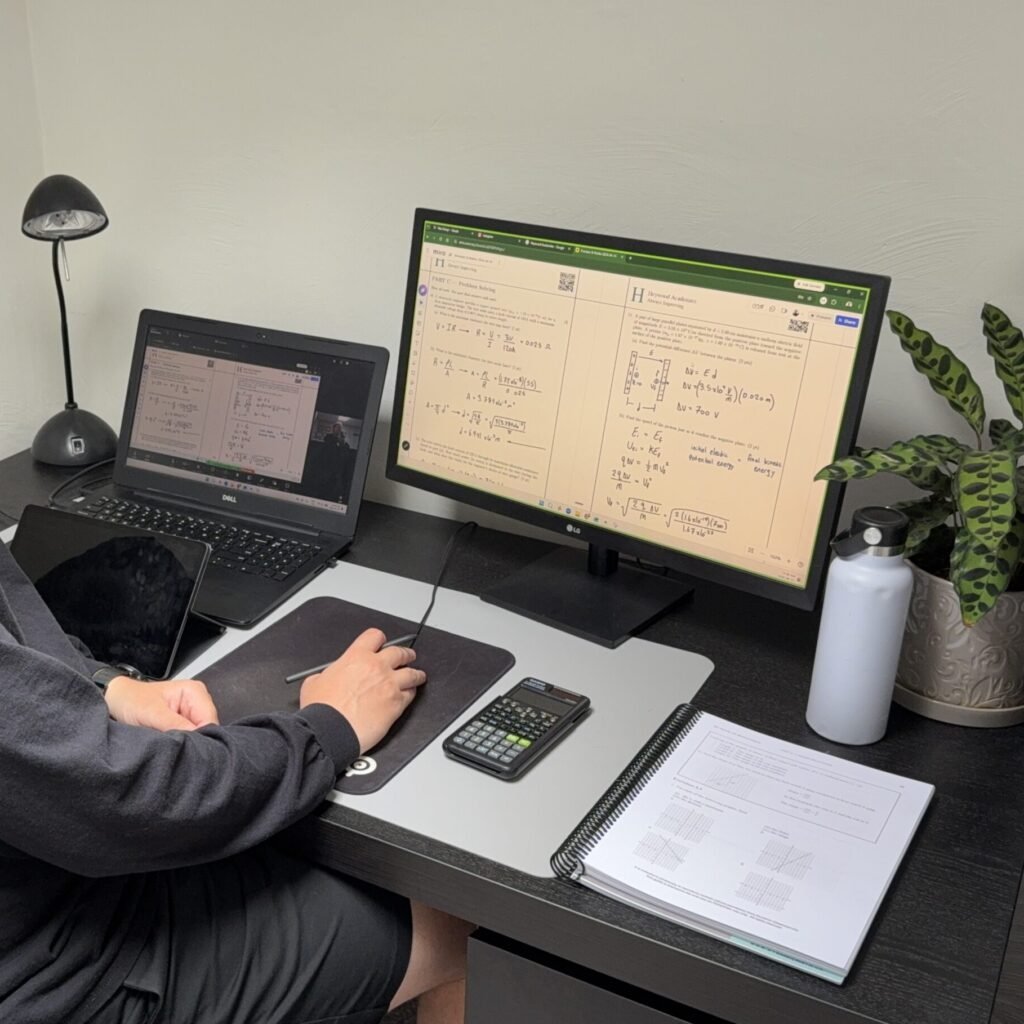
A lot of students assume they’re bad at physics. After a few tests that didn’t go well, it starts to feel like physics is just one of those subjects that some people get and others don’t.
That’s usually not what’s going on.
Most students who struggle with Physics 11 and 12 in BC are struggling because their math isn’t solid enough yet. Physics and math are deeply connected. If algebra, unit conversions, or rearranging equations feel shaky, physics problems are going to feel impossible. Not because the physics is hard, but because the math underneath it is slowing everything down.
That’s the real problem. And it’s one you can fix.
Physics Is a Math Course as Much as a Science Course
This catches a lot of students off guard. In Science 10, you can get by with a general understanding of concepts. Physics 11 and 12 require you to set up equations, rearrange them, plug in numbers carefully, and track units through every step of the calculation.
If your algebra isn’t automatic, you’re spending mental energy on the math instead of actually thinking about the physics. That makes everything harder than it needs to be.
The answer isn’t to give up on physics. It’s to work on the math at the same time. A tutor who can see exactly where the gap is can usually close it faster than you’d expect.
Draw the Diagram Every Time
This is one of the most consistent differences between students who do well in physics and students who don’t.
Before you write a single equation, draw the problem out. For any forces question, that means a free body diagram showing every force acting on the object, with arrows indicating direction. For kinematics problems, sketch the motion, label what you know, and mark what you’re solving for.
It feels like extra work. It isn’t. Students who skip the diagram and jump straight to equations make more errors, miss forces, and drop marks they shouldn’t drop. Drawing the problem forces you to think about what’s actually happening before you start calculating.
Even if the problem looks simple, draw it out. The habit pays off when the problems get harder.
Write Your Units Down and Follow Them
Units are not optional in physics. They are part of the answer, and they are one of the most useful tools you have for catching mistakes before they cost you marks.
Write the unit next to every number you put on paper. When you’re doing calculations, carry the units through each step the same way you carry numbers. By the end of the problem, your units should cancel out or combine into the unit the answer is supposed to be in. If they don’t, something went wrong and you can go back and find it.
Students who track units consistently make fewer calculation errors and are much better at checking their own work.
Where Students Struggle Most in Physics 11
Physics 11 in BC covers kinematics, dynamics, energy, waves, and modern physics.
Kinematics and dynamics are where most students first run into trouble. Kinematics requires you to work with displacement, velocity, and acceleration at the same time, keeping careful track of which direction is positive and which is negative. Dynamics adds forces to the picture and free body diagrams become essential.
Energy is more manageable for most students once they understand conservation of energy, but the calculations still require careful setup.
Waves and modern physics are conceptually different from the earlier units and catch students off guard if they’ve been getting by on formula memorization rather than actually understanding what the formulas mean.
Where Students Struggle Most in Physics 12
Physics 12 builds directly on Physics 11. It covers dynamics in more depth, circular motion, energy and momentum, electrostatics, electric circuits, electromagnetism, and an introduction to modern physics.
The jump from Physics 11 is real. Circular motion and electrostatics are the units that trip up the most students. Electrostatics requires solid algebra and comfort with vectors, and students who found Physics 11 manageable are sometimes caught off guard by how much harder Physics 12 feels.
Two Workbooks Worth Having
If you want more practice problems than your class provides, two workbooks are worth picking up.
Callan’s Grade 11 Physics and Grade 12 Physics by Ryan Callan are built around the BC Curriculum Every problem comes with a full step-by-step solution, not just a final answer. That’s what makes them useful. You can also find these on Amazon.
SNAP Physics 11 and Physics 12 by Castle Rock Research are specifically written for the BC curriculum. They include notes, examples, and practice tests for each unit. Available at solaro.ca or at local bookstores that carry school resources.
Both are worth having if you want to do more practice than your class assigns.
Video Resources: 100 Practice Problems
If you want to watch problems being solved step by step, these two videos cover the main Physics 11 units in depth.
Kinematics and Dynamics covers the units where most students first run into trouble in Physics 11. 100 practice problems solved from start to finish.
Work, Energy, and Momentum picks up where kinematics and dynamics leave off. Another 100 problems solved in full.
Both videos are around three hours each. You don’t have to watch them straight through — use them as a reference when you get stuck on a specific type of problem.
Using AI for Physics: What Actually Works
AI tools can be useful for checking your answer to a physics problem. Type in the question, get the answer, and compare it to yours.
Where AI falls short is in generating solutions. Even when you tell it to solve a problem using high school physics, it often pulls in university-level methods. The solutions it gives are technically correct but use concepts and approaches that don’t match what your teacher is looking for. Following an AI solution on a Physics 11 or 12 problem can leave you more confused than before.
Use AI to check answers. For learning how to actually solve problems, you need solutions written at the level of the course you’re in.
One more thing: make sure any use of AI tools lines up with your school’s academic integrity policy. If you’re not sure, ask your teacher before using it on anything that gets marked.
When to Get Help
If you’re dropping marks consistently and you can’t tell whether it’s the physics concepts or the math underneath them, that’s worth sorting out sooner rather than later. Physics 11 and 12 are cumulative. Gaps in earlier units make later units harder, and the courses move fast.
At Heywood Academies, we tutor high school students in Victoria, BC in Physics 11 and Physics 12. If you want to get back on track before the next test, we’d be glad to help.
Frequently Asked Questions
Why is Physics 11 so hard in BC? For most students it comes down to math. Physics 11 requires solid algebra and comfort with rearranging equations. If those skills are shaky, the physics feels harder than it actually is. Working on both at the same time is usually the fastest way to improve.
What is the hardest unit in Physics 12? Circular motion and electrostatics trip up the most students in BC Physics 12. Both require strong algebra and a solid grasp of vectors. Electrostatics builds directly on Physics 11 dynamics, so any gaps from the earlier course tend to show up quickly.
What are the best resources for BC Physics 11 and 12? Callan’s Grade 11 and Grade 12 Physics workbooks by Ryan Callan have hundreds of fully solved practice problems and are widely used by students across Canada. The SNAP Physics 11 and 12 workbooks by Castle Rock Research are written specifically for the BC curriculum and include unit practice tests.